Key Takeaways
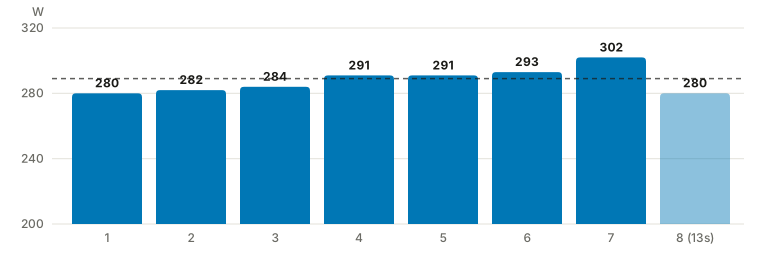
- The legs held the number. The heart did not. — 289 W average for 7:11, rising from 280 W in minute one to 302 W in minute seven. Power gave no warning. Heart rate went from 142 to 174 bpm in under six minutes and then had nowhere left to go.
- The target was wrong before I clipped in — The workout was built on a 275 W FTP from my Garmin profile. That number was set on a different power source. On the Technogym bike it put the 20-minute target above my threshold.
- Fail fast, then lower the anchor — Provisional FTP on this bike is now 248 W. The retest in the week of October 26 opens at about 255 W and only goes up in the last five minutes if heart rate allows.
What happened on the bike
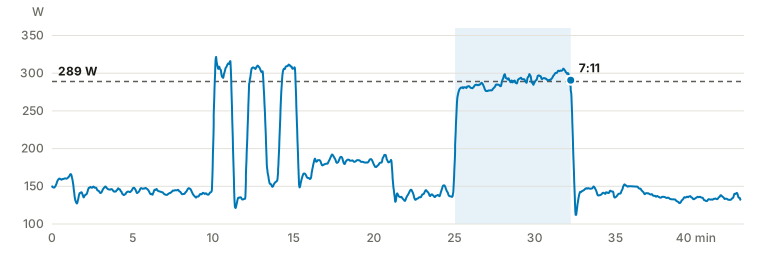
On the morning of October 24 I sat on a Technogym bike for a 20-minute FTP test. The workout on my Garmin was built off a 275 W FTP, which made the 20-minute target 289 W (275 divided by 0.95, the standard rule). Warm-up: 10 minutes easy, three 1-minute openers at about 305 W with a minute easy between, then nine more easy minutes.
The test lasted 7 minutes and 11 seconds. I averaged 289 W, on target to the watt, at a steady 90 rpm. Then I stopped. Not a slow fade. The power simply ended.
The power trace says nothing was wrong
If you only looked at power you would call this a well-paced start. Minute one was 280 W, minute seven was 302 W. That is a slow build, which is exactly what every coach tells you to do. If anything I was getting stronger.
| Minute | Power (W) | Avg heart rate (bpm) |
|---|---|---|
| 1 | 280 | 150 |
| 2 | 282 | 160 |
| 3 | 284 | 164 |
| 4 | 291 | 166 |
| 5 | 291 | 169 |
| 6 | 293 | 172 |
| 7 | 302 | 172 |
Heart rate told the truth
Heart rate was 142 bpm when the block started. It reached 174 bpm at 5:44, a rise of 32 beats in under six minutes, and then flattened at 172 to 174 for the rest of the effort. A plateau that close to the ceiling with more than 12 minutes still to go means only one thing: I was above threshold and paying for every minute out of anaerobic reserves. The effort was finished long before my legs admitted it.
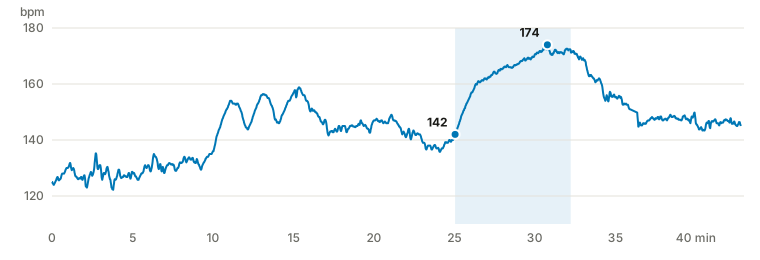
This is the part I find useful beyond cycling. Power was the metric I was managing, so power looked perfect. Heart rate was the metric I was not managing, and it was the one carrying the real signal. The number stopped measuring the thing the moment I started steering by it alone.
Why it failed: the anchor was wrong
The 275 W FTP in my Garmin profile was not set on this bike. Power readings differ between a gym bike, a smart trainer and a pedal power meter, often by several percent on the same effort. A target that was fair on one device can sit above threshold on another. I carried the number over without checking it, and the test did the checking for me.
The 95% rule itself has wide error bars too. A 2018 study of 23 trained cyclists (Borszcz et al.) found the 20-minute estimate accurate on average, with individual errors up to about 60 W either way. So an FTP is an anchor for training zones, not a fixed truth. Mine was simply anchored in the wrong place.
What I changed for the retest
- Provisional FTP on the Technogym bike: 248 W. Conservative on purpose. Better to train a week slightly easy than to build every zone off a number this bike does not support.
- Retest in the week of October 26, opening at about 255 W. Hold that for the first five minutes, then decide.
- Heart rate gate at minute five. If it is already in the low 170s, drop 5 to 10 W right away instead of waiting for the legs to vote.
- Only build in the last five minutes. A test that ends with me pushing harder gives a better number than one that starts hot and stops at seven minutes.
- Same bike, same time of day, a fan on the torso, no heavy legs in the 48 hours before.
I will add the retest file to this page once it is done. If you want the full protocol written up as a checklist, with the research behind the warm-up and the three common test formats, it is on hybridathlete.guide. For keeping the room cool during the effort, see my indoor cycling fan guide.
Why did my FTP test fail even though I hit the target power?
Because the target was above your threshold on that day and that device. Power can hold for several minutes above threshold while heart rate climbs and anaerobic reserves drain. In my test, power averaged exactly 289 W for 7:11 while heart rate went from 142 to 174 bpm, and the effort ended once those reserves ran out.
Should I redo a failed FTP test the same day?
No. The effort you already spent makes the second attempt slower, so the number comes out too low. Cool down, set a provisional FTP below the old one, and retest within one to two weeks.
How should I pace a 20-minute FTP test?
Open the first five minutes at about 95% of your goal power, hold through the middle, and only raise power in the last five minutes. If heart rate is already near your maximum by minute five, drop 5 to 10 W straight away.
Does FTP transfer between a smart trainer, a gym bike and a power meter?
Not reliably. Different power sources can disagree by several percent on the same effort. Treat FTP as valid only for the device that measured it, and test again when you change bikes.
Ready to Train Smarter?
Get personalized training zones, race predictions, and performance insights with our free calculators.
