
Short answer: weather maxing means arranging where you spend each month so that you are almost always in the weather you like best, and moving when somewhere else is clearly better. If your work is not tied to a city, weather is a choice you make every month. Most people make it once, when they pick where to live, and then put up with the result for decades.
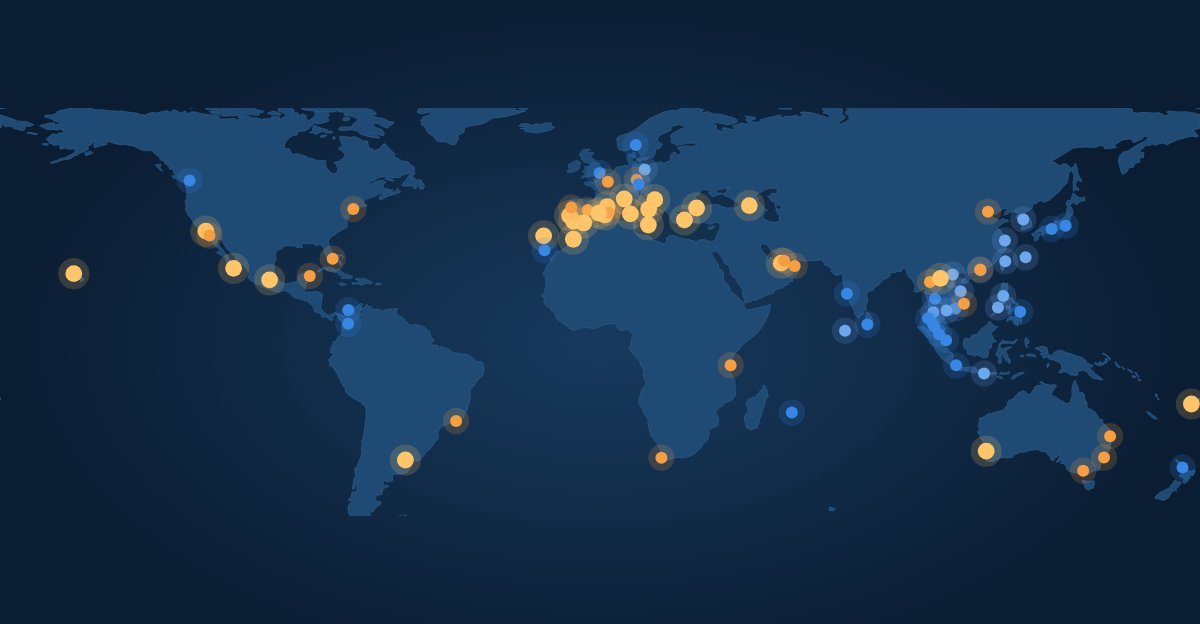
I check the weather the way I check a training log: daily, and with a dashboard. It covers 82 cities with five years of daily data each, and it gets a vote on where I spend every month. This piece explains how it works, the rotation it gives me, and what the data says that reputation does not. You can try it with your own preferences on the weather maxing map.
What does weather maxing actually optimise?
Your criteria, not anyone else's. "Good weather" isn't one thing. Someone who wants a deep tan, someone who wants to run at 6 a.m. without dripping, and someone who misses autumn want three different places in the same month. The first step is writing your criteria down as numbers, because "warm and sunny" matches half the planet in July.
These are the ones that matter, roughly in order of how much they decide:
| Criterion | Measure | Mine |
|---|---|---|
| Heat | Average daytime high | 25–31°C (77–88°F) |
| Stickiness | Dew point, not humidity | Under 19°C |
| Rain | Days a month with at least 1 mm | Nine or fewer |
| Sun | Cloud cover | Mostly clear |
| Tan | Noon UV index | 8 or more |
| Training | Morning low, dew point, air quality | Runnable at 6 a.m., AQI under 50 |
| Seasons | Gap between warmest and coolest month | Don't need them |
The last row splits people more than any other. Some people find the same 30°C every day relaxing. Others find it flattening and want a proper autumn every year. Neither is wrong, but it decides the whole map. "Eternal spring" cities like Mexico City, San Diego or Los Cabos have a seasonal swing of 6 to 8°C between their warmest and coolest months. Fürth, where I grew up, swings by more than 20°C. Singapore swings by less than 2°C.
Why is dew point the number that matters?
Because relative humidity misleads you. 80% humidity at 21°C is a pleasant evening. 55% at 38°C is miserable. Relative humidity is measured against the temperature, so it tells you very little on its own. Dew point is the absolute amount of water in the air, and it tracks what your skin feels: under 16°C is comfortable, 19°C is sticky, and above 22°C sweat stops evaporating.
This is where the data has been hardest on my own habits. Singapore, where I'm writing this, has a mean dew point of about 23 to 25°C in every single month. Bali's best month is still 21.6°C. Ho Chi Minh City sits at 24 to 25°C from May to October. Southeast Asia is not hot so much as wet air you can't get away from. Its good months are its dry seasons, and even those only just get under my limit.
Shanghai, where I spent the summer of 2025, reached a mean dew point of 24.9°C and a mean AQI of 112 in July. A tropical July has better air than that. If I had looked at the numbers first, I would have planned that summer differently.
What does my weather maxing rotation look like?
It's not a perfect weather rotation, and I don't think a perfect one exists for anyone who works. Client hours in US time zones, gyms I trust, flights and visas all have a vote. Weather breaks the ties, and it decides when I move. Here is the shape of the last twelve months, with each stop scored by the map on my own settings:
| When | Where | Why | Score |
|---|---|---|---|
| Nov–Feb | Ho Chi Minh City, Bangkok | Dry season, and the only stretch when the dew point gets down to about 20°C or below. | 50–64 |
| March | Perth (a week) | Late summer: 29°C, five rain days, and some of the cleanest air on the list. | 90 |
| Apr–Jul | Ho Chi Minh City | Not for the weather. Wet season, 24°C dew point. I stay for work and the time zone. | 26–35 |
| Aug–Oct | Bali (Canggu) | Dry season. Coolest nights, clearest skies and the strongest UV of the island’s year. | 54–66 |
| Sep–Oct | Los Angeles | The best months there. 27–31°C, dry air, two rain days. | 81–83 |
Right now it's the end of October. Bali's dry season is ending, I'm in Singapore, and in November I move back to Vietnam and Bangkok, where the dry season starts and lasts until February. Los Angeles was the surprise of last month: late September and October are its best weather of the year, with highs of 27 to 31°C, dew points around 11 to 15°C and almost no rain. July and August are hotter, with highs of 31 to 32°C.
The 12-month planner in the tool makes the trade-off plain. With my settings and no limit on moves, it would send me to Perth and Buenos Aires for the southern summer, Los Cabos for the spring, and Spain and Portugal for the northern summer. I don't do that, because the weather is only one input, and I've written about what a time zone costs. Weather maxing is one criterion among several when you choose a base city, not a replacement for them.
If you're working out where to go, ask me where I am. The current stop is usually somewhere on this list.
Where is the best weather in each month?
For warm, dry, not-muggy weather, the year falls into four blocks. These are the cities that lead the map on my settings across 82 cities:
- November to February: the southern hemisphere. Perth, Buenos Aires and Cape Town lead, with Los Cabos the best northern option. Chiang Mai and Luang Prabang have their cool, dry season and make the top five in December and January. Bangkok and Saigon are at their best too, though the burning season pushes Bangkok's mean AQI to 131 to 144 in January and February.
- March to May: Los Cabos leads all three months, with Perth in March and Marrakech and Mexico City in April and May. Southeast Asia is at its hottest: Bangkok's average high is 34°C in April.
- June to September: the Mediterranean and Portugal: Marbella, Valencia, Lisbon, the Algarve, Nice and the Greek islands. Los Angeles makes the top two in June.
- October: Honolulu, Brisbane and Los Angeles. In Southeast Asia, Bali's dry season from July to October is the best window, and it peaks at 66 on my settings.
The full month-by-month list, with the top three for each month, is on the map page. Change the settings and the list changes with them.
How do you plan a year of good weather?
- Write your limits as numbers. A daytime high range, a dew point ceiling, a rain-day limit, and whether you need UV, training conditions or seasons.
- Score places by month, not by reputation. "Bali has great weather" is true for about four months a year. "Bangkok in November" sits right on the edge of the dry season.
- Price each move. A move costs one or two working days, a training week that starts badly, and often a visa clock. Only move if the better weather lasts longer than that.
- Pick anchors, then fill the gaps. Two or three bases you know well beat twelve new cities, because the gym, the café and the running route are already sorted.
- Recheck before you book. Averages are averages. One October can be twice as wet as the mean, so look at the 16-day forecast in the week before you fly.
Is weather maxing worth the moving?
For me, yes, and the reason is training more than tanning. A month at a 24°C dew point costs me pace on every run, sleep on every night without air conditioning, and some motivation by the third week. A month in Perth or Los Angeles in the right season gives all of that back. The weather is the cheapest performance input I have, because once I've chosen the place, I don't have to think about it again for weeks.
The trap is the one this site keeps coming back to: optimising the number until it stops measuring the thing. A rotation that scores 90 every month but means you never see the same friends twice is not a good year. The score is a tool for choosing places. It shouldn't be what you're living for.
Frequently Asked Questions
What is weather maxing?
Weather maxing means choosing where you spend each month so you are almost always in the weather you like best, and moving when somewhere else is clearly better. It takes location-independent work, and it works best when you write your criteria down and score places by month instead of going on reputation.
Where is the best weather in the world?
There is no single place, because the best weather moves with the seasons and depends on what you like. For warm, dry and not-muggy weather, the southern hemisphere leads from November to February (Perth, Buenos Aires, Cape Town), the Mediterranean and Portugal from June to September, and Southern California and Los Cabos in the months between.
How do you chase summer all year?
Alternate between hemispheres, or between a place's dry and wet seasons. A simple loop is the Mediterranean or Southern California from May to October, then Australia, South America or a Southeast Asian dry season from November to April. Move only when the gain lasts several months, because each move costs you working days.
What dew point is comfortable?
Under about 16°C (60°F) feels comfortable to most people, 16 to 19°C is noticeable, 19 to 22°C is sticky, and above 22°C feels oppressive. Dew point is a better guide than relative humidity, because it measures the actual moisture in the air whatever the temperature.
What UV index do you need to tan?
Most skin tans at UV 3 and above. At UV 8 and above it happens quickly, and so does burning: fair skin can burn in under 15 minutes. Peak UV depends on how high the sun is, so the tropics reach 10 or more all year, while Europe only gets there in midsummer.
